
The Art of Johannes Kunst
1968- 2017
*Double Click on Image to see Gallery Pictures
1968-1975 : The Early Works
In these early works, Johannes begins the process of defining his visual language. The paintings move between instinct and intention, where figures appear in raw, expressive forms before gradually giving way to structure, symbol, and system.
What emerges is not a linear progression, but a process of discovery. Forms are tested, repeated, and reimagined, as Johannes searches for a way to hold experience within the picture plane. The work shifts from direct expression toward a more constructed language- one that will continue to develop across the decades that follow.


The Circle Series
Beginning in 1972, Johannes' isolates the circle as a primary form, transforming it from a recurring motif into a generative system. Inspired by the looping structure of a found mattress spring, the circle becomes both unit and language- capable of repetition, variation, and expansion.
These works move between intuition and construction. Lines intersect, cluster, and disperse, suggesting unseen frameworks beneath the surface. By 1973, the compositions shift toward greater clarity and order: circles evolve into dots, grids emerge, and color is applied with increasing precision, yet, Johannes often adds subtle imbalance. What begins as an organic field becomes a structured environment.
Across the series, Kunst explores how simple forms can hold complexity-how repetition creates rhythm, and how structure can emerge from instinct. The result is not static geometry, but a living system- one that reflects both the chaos and coherence of experience.


The Attic Series
In the Attic Series, the darkness of war is transformed into a sanctuary of the mind. Johannes builds a private world from line, symbol, and luminous color-a place where imagination becomes survival. Within these intimate spaces, figures and symbols move freely, reshaping memory into something livable. These works are not about confinement, but about resilience: the quiet insistence that even in shadow, the mind can create light.


The Waldo Series
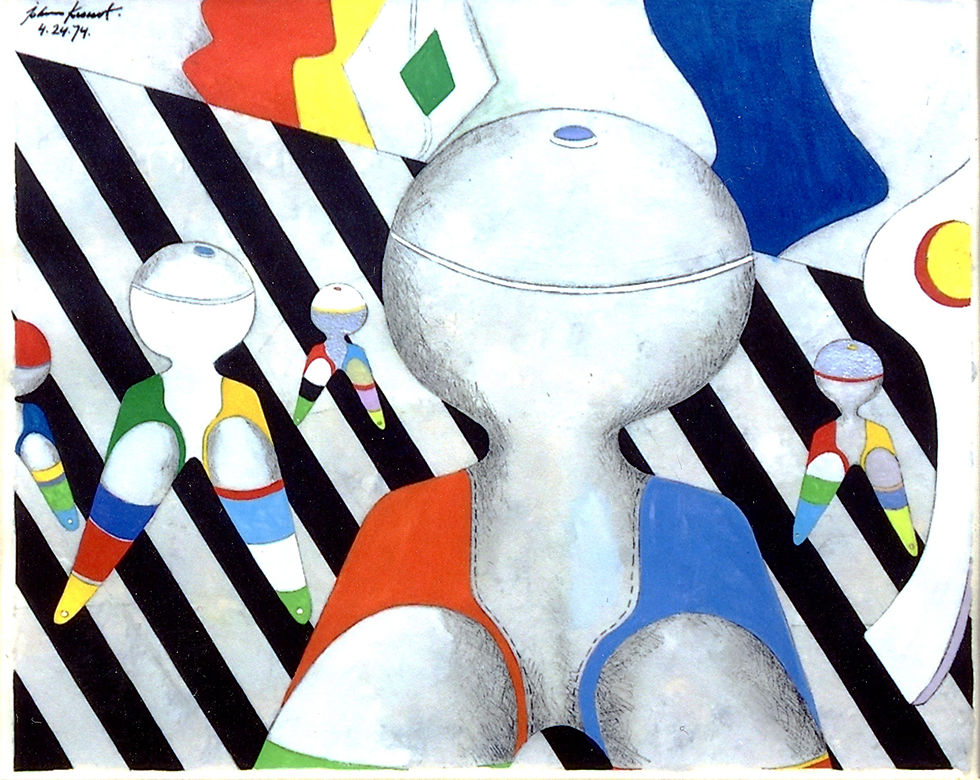
In the Waldo Series, Kunst develops a visual language built on repetition, variation, and subtle disruption. Figures appear in sequences that echo one another, forming patterns that suggest order, crowd, and system. Yet within this repetition, no figure is entirely the same. Small shifts- of gesture, proportion, or placement- quietly assert individuality against uniformity. The work moves between anonymity and presence, asking whether identity can endure within structures that tend to absorb or erase it. Here, Johannes begins to articulate a central concern that runs throughout his work: the fragile persistence of the individual within the collective


Hanke Design: World Class Greeting Cards
Johannes' vibrant, protective motifs served as a shared visual lullaby for a global audience, proving that the heart's need for beauty knows no borders. The Hanke line remains a testament to his ability to transform deep, technical mastery into a celebrated, universal language of joy.


The Humanitarian Years: 1987-2017
The years in the Netherlands marked a profound rebirth in the life and work of Johannes Kunst. By this time, painting had become something more than a means of survival. It became a form of conscience. Johannes began to use the canvas not only to express himself, but to defend what he believed was fragile in the world.
Looking outward, he saw a planet under strain and responded with a series of powerful humanitarian works- paintings that functioned as visual manifestos. During this period several important bodies of work emerged.


Johannes' Sketchbooks: 1970-2016
The sketchbooks show an artist fully engaged in process. Some ideas are resolved, many are not, but all of them matter. You can feel that he got as much satisfaction from this exploration as from any finished painting. That tells me everything about who he was- someone committed not to outcome, but to practice.
These sketchbooks are not secondary to the paintings- they are the foundation. They are where the thinking lives, where the language forms, and where the artist is most visible.


